

Ask any couple who has planned a large Indian wedding what the most stressful part of the whole experience was, and most of them will not say the venue search or the catering negotiation or the outfit decisions. They will say the guest list. Not the initial writing of names, which is stressful in its own way, but the ongoing management of it. The tracking, the chasing, the updating, the explaining, the correcting, and the inevitable moment two weeks before the wedding when someone asks whether their cousin who confirmed three months ago is still coming and nobody can find the original message.
Guest management at a large Indian wedding is a category of problem that most planning tools were not built to solve. It is not just a headcount problem. It is a communication problem, a social complexity problem, and a logistics problem all at once, and the tools most couples use, spreadsheets, WhatsApp threads, and generic RSVP forms, handle each of these badly in their own specific way. Indivites was built to handle all of them together, and the way it approaches guest management is one of the most practically useful things about the platform.
The Scale of the Problem
A typical large Indian wedding in the US has between 300 and 500 guests. Across a five-event celebration, that guest list is not one list but several overlapping ones, each with different people, different headcounts, and different information requirements. The Haldi might have 40 people. The Mehendi might have 120. The Sangeet might have 280. The wedding ceremony might have 350 and the reception 450.
Each of those numbers needs to be accurate at a specific point in time so that vendors can be briefed, seating can be arranged, catering can be ordered, and the event can actually run smoothly. Getting any of those numbers wrong by a meaningful margin has a direct financial cost, and getting them wrong in the wrong direction, significantly underestimating attendance, has a hospitality cost that is just as significant on the day.
Managing all of this through a spreadsheet that is manually updated based on WhatsApp responses is not just tedious. It is structurally unreliable, because the information flow between guests confirming and the spreadsheet reflecting that confirmation depends entirely on someone remembering to do the update every single time. In practice, that does not happen consistently, which means the numbers the couple is working from are always slightly behind reality.
How Indivites Approaches the Guest List
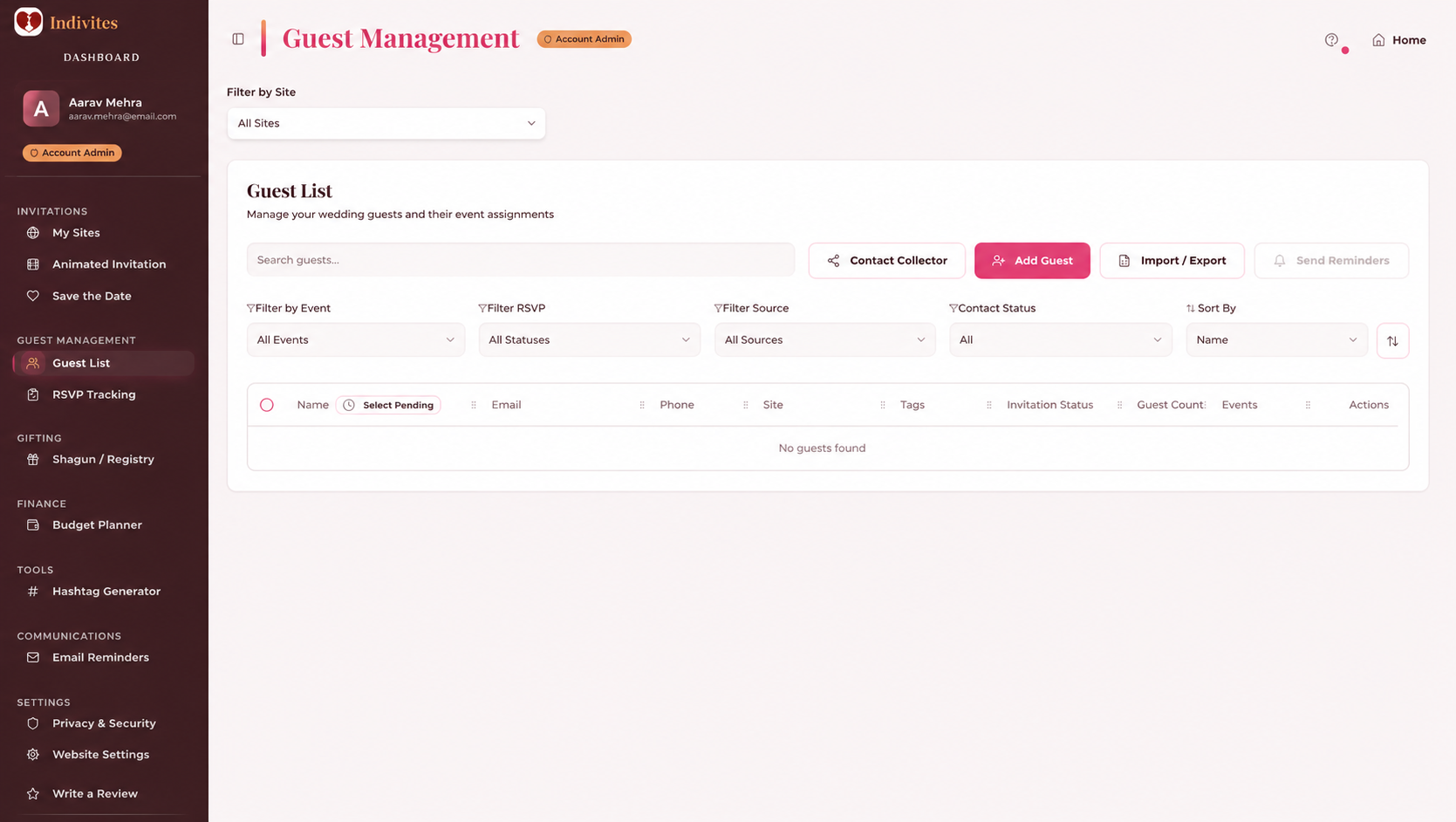
When you set up your wedding on Indivites and begin adding guests, the process is designed around the reality of how Indian wedding guest lists actually work rather than how a simpler version of them would work.
Each guest is added individually with their name, contact details, and a tag that helps organize the list. The tagging system lets you group guests as VIP, Family, Friend, Colleague, or any custom category that makes sense for your specific wedding. For a large Indian wedding where the guest list includes the couple's immediate family, extended family on both sides, friends from different chapters of life, colleagues, and community members, this kind of organization is not a luxury. It is what makes the list navigable.
When you add a guest, you also assign them to the specific events they are invited to. This is the part that makes Indivites fundamentally different from any other approach to guest management. Rather than maintaining one master list and then trying to filter or segment it separately for each event, the event assignment is built into the guest record from the start. Every guest has a clear, stored profile of which events they are attending, and that profile is what drives their invitation, their RSVP request, and their headcount contribution.
For family groups attending together, the platform lets you add up to six people under one invitation, which keeps the list clean and avoids the confusion of sending multiple separate invitations to a household that is clearly coming as a unit.
Per Event RSVP Tracking in Real Time
Once guests are added and their events are assigned, the RSVP tracking begins automatically when invitations go out. Every response a guest submits updates the couple's dashboard in real time, and the dashboard shows confirmed, declined, and pending counts separately for each event.
This means that at any point during the RSVP window, the couple can open their dashboard and see exactly where they stand for each function individually. If the Sangeet has 80% of responses in and the Mehendi only has 50%, that tells the couple where to focus their follow-up effort without having to cross-reference multiple sources to figure it out.
The automatic reminder system handles a significant portion of that follow-up effort without the couple needing to do anything manually. Guests who have not responded receive reminders through the platform, which removes the uncomfortable task of personally chasing friends and relatives who have gone quiet.
Dietary requirements are collected alongside the RSVP at the point of confirmation, which means the couple ends up with a complete per-event picture of both headcount and meal needs without sending a separate follow-up communication. When the caterer needs a final count for the reception including a breakdown of dietary requirements, that information is ready to export from the dashboard rather than being assembled from scattered messages.
The Social Complexity That Guest Management Tools Usually Ignore
There is a dimension of Indian wedding guest management that goes beyond headcounts and dietary requirements, and it is the one that causes the most stress for couples and families. That is the question of who is invited to what, and how to communicate those distinctions without creating awkwardness or hurt feelings.
In Indian wedding culture, the differences between who is invited to each function are socially significant. Being invited to the Haldi is a mark of closeness. Being invited only to the reception is also perfectly appropriate and reflects a different kind of relationship. But communicating this clearly, in a way that makes every guest feel considered rather than categorized, requires a level of precision and personalization that generic communication tools cannot provide.
Indivites handles this through guest level event visibility. Each guest's invitation shows only the events they are attending. There is no need to add awkward language explaining that certain parts of the invitation do not apply to them. There is no risk of a guest feeling confused about whether they are welcome at a particular function because the invitation they received makes it completely clear. And because personalization is built into the system rather than depending on careful manual management, there is no risk of a mistake where someone receives information about an event they were not meant to attend.
The forwarding protection adds another layer to this. If a guest shares their invitation link, the person who receives it sees only the events assigned to the original invitation. Private functions stay private even when links are shared casually, which is an entirely realistic scenario in the age of messaging apps where sharing links takes two seconds.
Guest Notes, Tags, and the Details That Matter
Beyond the event assignment and RSVP tracking, the guest management system on Indivites includes features that address the smaller but genuinely important details of managing a large guest list.
Notes can be added to individual guest records, which is useful for keeping track of anything relevant to that person's experience at the wedding. A guest who needs wheelchair accessibility at the venue. A family that is arriving from abroad and needs to know about the hotel block. A relative who has a severe food allergy that should be flagged directly to the catering team rather than just appearing in the dietary requirements count. These notes live in the guest record and are accessible from the dashboard whenever they are needed.
The tagging system also makes it easier to communicate with specific segments of the guest list without broadcasting to everyone. If there is an update that affects only the guests attending the Sangeet, the information can be directed to that group specifically rather than going to three hundred people, most of whom do not need it. Targeted, relevant communication is one of the things that makes guests feel considered rather than managed, and the organization built into the Indivites guest list makes it possible to communicate that way even at scale.
What the Couple Actually Experiences on the Other Side
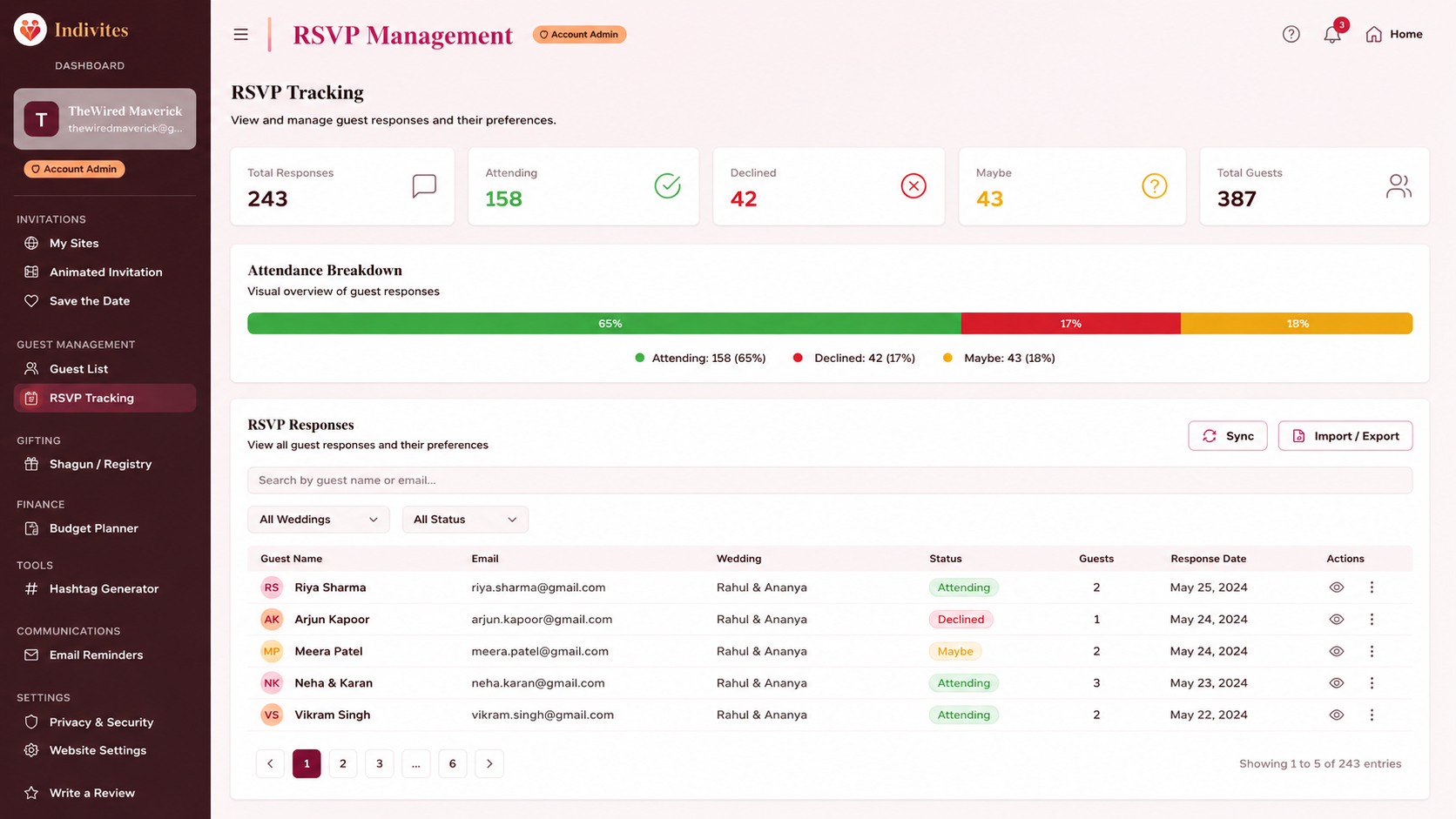
The way Indivites guest management feels to use is worth describing because it is different from the experience most couples have with other approaches. Rather than spending the pre-wedding period constantly updating a spreadsheet and chasing responses through different channels, the couple opens one dashboard and sees a current, accurate picture of where their wedding stands.
The headcounts are live. The dietary breakdowns are ready. The pending RSVPs are visible and reminders are going out automatically. The notes about individual guests are accessible when needed. The budget tracker is in the same view, so the guest counts and the catering budget are always visible together. The Shagun gifts are appearing in real time with the personal messages attached.
This is what planning a complex Indian wedding should feel like, not perfectly smooth because weddings are never perfectly smooth, but organized and visible rather than chaotic and opaque. Indivites does not remove the complexity of a large multi-event Indian wedding. It makes that complexity manageable in a way that leaves the couple with enough mental space to actually enjoy the weeks before their celebration rather than spending all of it on administration.
Frequently Asked Questions
How many guests can I manage on Indivites? Indivites is built for large South Asian weddings with guest lists that can run into the hundreds. The platform handles scale without requiring the couple to manage different tools for different sizes of list.
Can I organize my guest list by family or relationship type? Yes. The tagging system lets you label guests as VIP, Family, Friend, Colleague, or any custom tag you create. This makes the list navigable and makes it easier to communicate with specific groups when needed.
What happens when a guest declines an event but wants to attend a different one? Each event is tracked separately, so a guest can decline the Mehendi and confirm for the Sangeet and the reception without any confusion in the system. Their headcount contribution updates per event based on their actual responses.
Can I see which guests have not yet responded without going through the whole list manually? Yes. The dashboard shows pending responses separately from confirmed and declined, and you can see at a glance which events still have significant non-responses. The automatic reminder system also handles follow-up for non-responders without the couple needing to reach out individually.
How does Indivites handle a guest who wants to bring an additional person not on the original list? You can update a guest's record at any time to add additional attendees within their party, and the headcount for the relevant events updates automatically. For guests who want to bring someone entirely new, you add them as a separate guest and assign their events.
Can dietary requirements collected through Indivites be exported for the caterer? The information collected through the RSVP process, including headcounts and dietary requirements per event, is available in the dashboard and can be shared with vendors directly. This gives caterers the specific, per-event breakdown they need without the couple having to compile it manually from different sources.