
There is an unspoken awkwardness that creeps into the Shagun moment at many modern Indian weddings. The tradition itself is clear and beautiful. Guests give blessings in the form of cash, couples receive them with gratitude, and the exchange carries the weight of generations of cultural meaning. But somewhere between the physical envelope and the digital transfer, the etiquette around how to set it up gracefully, how to communicate it without seeming greedy, and how to acknowledge it properly has become genuinely uncertain territory for many couples and their families.
This is especially true for Indian couples planning weddings in the US, UK, Canada, or Australia, where guests are navigating two cultural frameworks at once, where some relatives are deeply traditional and others are entirely comfortable giving digitally, and where the logistics of a multi-country wedding make physical cash gifting genuinely complicated for guests who cannot attend in person. The good news is that modern Shagun etiquette is not as complicated as it feels. It just needs to be approached with the same intentionality that goes into every other part of the wedding.
The Foundation Has Not Changed, Only the Format

Before getting into the etiquette of digital Shagun, it is worth being clear about what has not changed. The meaning of Shagun is identical whether the blessing arrives in a beautifully crafted physical envelope or through a thoughtfully designed digital gifting experience. The auspicious number tradition, giving 501 rather than 500 or 1001 rather than 1000, carries the same significance. The gesture is still an act of blessing rather than a financial transaction. And the couple's obligation to acknowledge it with genuine gratitude remains exactly what it has always been.
What has changed is the infrastructure. More guests are giving digitally, more weddings involve guests across multiple countries who cannot physically hand over an envelope, and more couples are proactively building digital Shagun into their wedding experience rather than leaving it as an afterthought. The etiquette evolves around the infrastructure, but the values underneath it stay the same.
How to Communicate Digital Shagun Without It Feeling Transactional
This is where many couples get anxious. There is a real cultural sensitivity around making Shagun feel like a request for money, which it is not. The way you communicate a digital Shagun option to your guests determines whether it feels elegant and considered or awkward and commercial.
The most graceful approach is to make it part of your wedding website rather than something mentioned in the invitation itself. Your wedding website is where guests go to find accommodation details, event schedules, and all the logistical information around the celebration. Including a beautifully designed digital Shagun section on the website, presented as a way for guests near and far to participate in this tradition, feels natural rather than forward. The invitation remains focused on welcoming guests to the celebration. The website gives them everything they need to participate fully, including the Shagun option.
The language matters enormously. Framing digital Shagun as a way for distant loved ones to feel present at the wedding, as an option for guests who prefer it, rather than as a substitute for physical envelopes or as an expectation, keeps the tone right. You are offering an elegant option, not making a demand.
For guests who are attending in person, the physical Shagun envelope remains entirely appropriate and should never be discouraged. Digital Shagun is most valuable as an addition to the tradition, not a replacement for it. The two can and should coexist at a modern Indian wedding without any awkwardness if the setup is handled thoughtfully.
The Design of the Experience Signals Respect
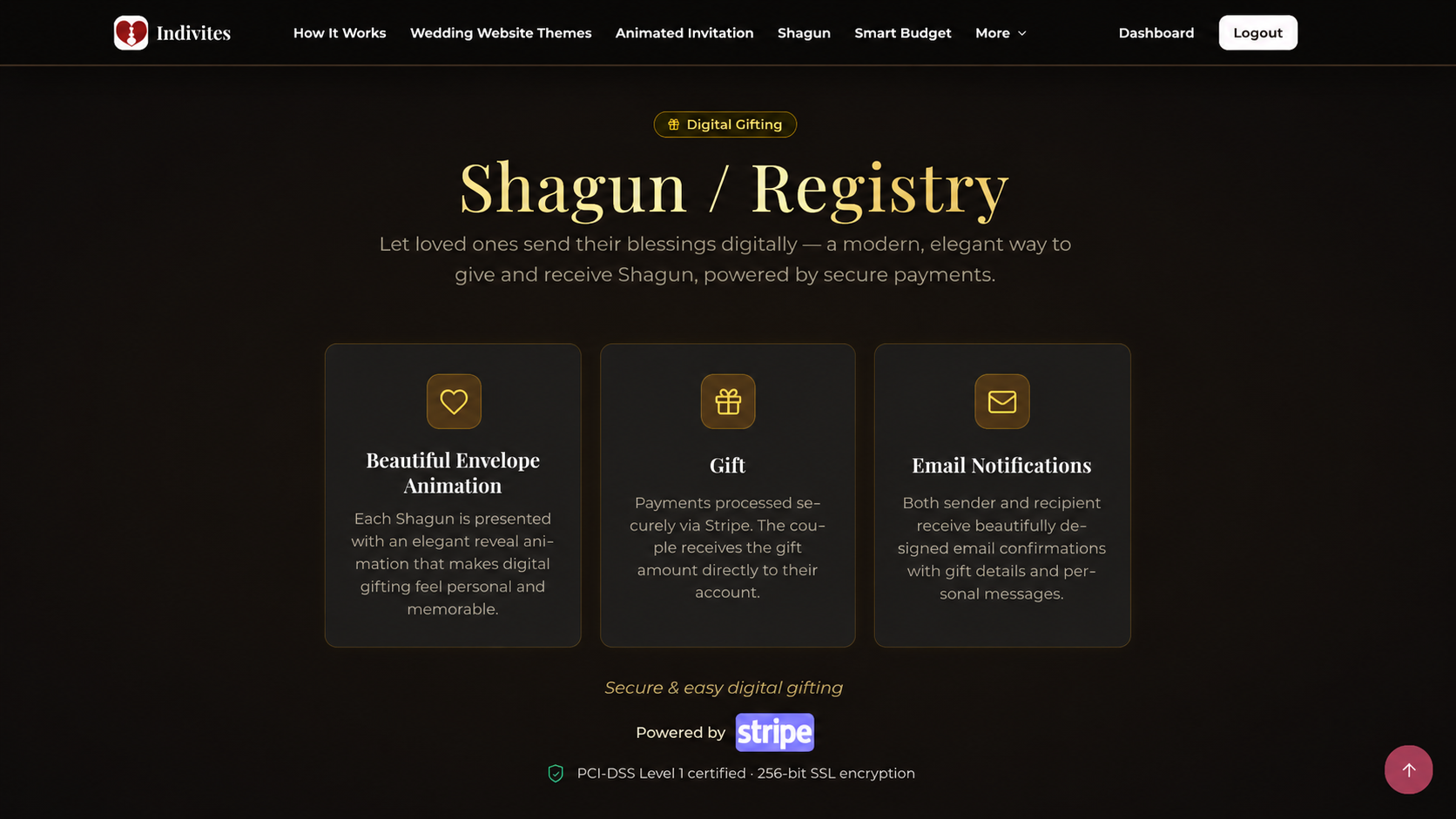
One of the most important things couples can do to elevate the Shagun etiquette on both the giving and receiving side is to use a platform that treats the experience as an occasion rather than a payment. This is the distinction that separates digital Shagun done well from a bank transfer with a memo line.
Indivites was built with exactly this in mind. The digital Shagun experience on Indivites is designed to feel like the ritual it is meant to be. Guests open a beautifully designed gifting interface that reflects the aesthetic of the wedding, write a personal note or blessing, choose their amount with the auspicious number tradition preserved, and send their Shagun as a gesture rather than a form submission. For the couple, every gift arrives with the giver's name, their message, and a complete record that makes acknowledgment possible and meaningful.
This design quality matters because it signals respect to the guest. When someone opens a cold, generic payment interface to give Shagun, the experience diminishes the tradition even if the intention is genuine. When they open something beautiful and considered, it honors both the giver and the receiver and makes the moment feel like what it is supposed to be.
Who Receives the Shagun Matters Too
This is a point that modern digital gifting platforms often miss entirely, and it is one of the most culturally specific aspects of Indian wedding gifting etiquette. Shagun at an Indian wedding is frequently given to the parents of the couple as much as to the couple themselves. A close family friend may direct their blessing to the bride's parents. An elder relative may choose to give to the groom's family. This is not a secondary consideration but a central part of how Shagun actually functions in Indian social fabric.
A well-designed digital Shagun experience should allow guests to direct their gift to whichever family member is appropriate, whether that is the couple, the bride's parents, or the groom's parents. When this option exists and is clearly presented, guests from traditional backgrounds feel that the digital experience genuinely understands the culture rather than flattening it into a one-size-fits-all payment. For couples using Indivites, this capability is built into the platform, which means the full social nuance of Shagun is honored digitally in the same way it would be in person.
Acknowledging Digital Shagun Gracefully
The etiquette of receiving Shagun, whether physical or digital, has always included a responsibility to acknowledge it with genuine gratitude. With physical envelopes, this has historically meant a personal phone call or visit after the wedding. With digital Shagun, the acknowledgment process becomes both easier and more important to do well.
The couple should aim to acknowledge every digital Shagun within two weeks of the wedding. A personal message that mentions the giver by name, references their note if they wrote one, and expresses specific gratitude rather than a generic thank you is significantly more meaningful than a broadcast message sent to everyone. The fact that digital Shagun comes with a complete record of who gave what and what they wrote makes personalized acknowledgment far more practical than it ever was with a pile of unmarked envelopes.
For guests who gave Shagun to the couple's parents, it is worth the couple coordinating with their parents to ensure those guests are also acknowledged specifically. This is a small but significant point of etiquette because it closes the loop of the gesture and tells the guest that their blessing reached the right person.
The timing matters too. Sending a thank you message while still in the early weeks of newly married life, before too much time has passed, keeps the warmth of the wedding moment alive. A message sent three months after the wedding carries a different emotional weight than one sent within the first fortnight, even if the words are equally sincere.
What to Do When Physical and Digital Coexist
At most modern Indian weddings, both physical envelopes and digital gifting will be present, and managing both gracefully is part of the couple's responsibility. The family member designated to collect physical envelopes should be briefed about the digital Shagun setup so they can direct guests who ask about it. There should be no moment where a guest is uncertain about how to give their blessing, digitally or physically, because that uncertainty creates the awkwardness that good etiquette is designed to prevent.
For guests who arrive at the wedding having already sent their Shagun digitally, there should be a graceful acknowledgment from the family. Not a public announcement but a quiet, personal recognition that their blessing was received. This might be as simple as a family member saying to them privately that the couple received their gift and message and is so grateful they participated from wherever they were.
This kind of thoughtfulness is what distinguishes a wedding that has genuinely good etiquette from one that has simply set up the right tools. The tools create the infrastructure. The human gestures on top of them create the experience.
Frequently Asked Questions
Is it appropriate to include a digital Shagun option on a wedding invitation? It is more appropriate to include it on the wedding website rather than the invitation itself. The invitation is focused on welcoming guests to the celebration. The wedding website is where all logistical and practical information lives, and a beautifully presented digital Shagun section there feels considered rather than transactional.
Should we discourage physical Shagun envelopes if we have a digital option? Never. Physical Shagun remains entirely appropriate and should be welcomed alongside the digital option. The two coexist naturally at a modern Indian wedding and trying to replace one with the other misunderstands what Shagun actually is, which is a gesture of blessing that can travel through any format.
How soon should we acknowledge digital Shagun after the wedding? Within two weeks is ideal. A personal message that references the giver by name and acknowledges any note they left is significantly more meaningful than a generic thank you. Digital Shagun makes this easier because the platform gives you a complete record of every gift and every message, so you are not trying to reconstruct who gave what from memory.
Can guests direct their digital Shagun to the couple's parents rather than the couple? On a well-designed platform like Indivites, yes. Guests can direct their blessing to the couple, the bride's family, or the groom's family, which honors the full cultural structure of how Shagun works at Indian weddings rather than simplifying it into a single account.
How do we communicate the digital Shagun option to guests who might not be comfortable with technology? Keep the communication simple and personal. A trusted family member in the elder guest's circle can walk them through the experience the first time or complete the process on their behalf. The platform should require no account creation and take under two minutes to use, which makes it accessible even for guests who are not particularly comfortable with digital tools.
Does Indivites make it easy to track and acknowledge all digital Shagun received? Yes. Every gift on Indivites is recorded with the giver's name, the amount, the note they wrote, and who they directed it to. The couple has a complete, organized record that makes personalized acknowledgment straightforward rather than a logistical exercise. For a wedding with guests giving from multiple countries across multiple events, this record is one of the most practically valuable things the platform provides.