
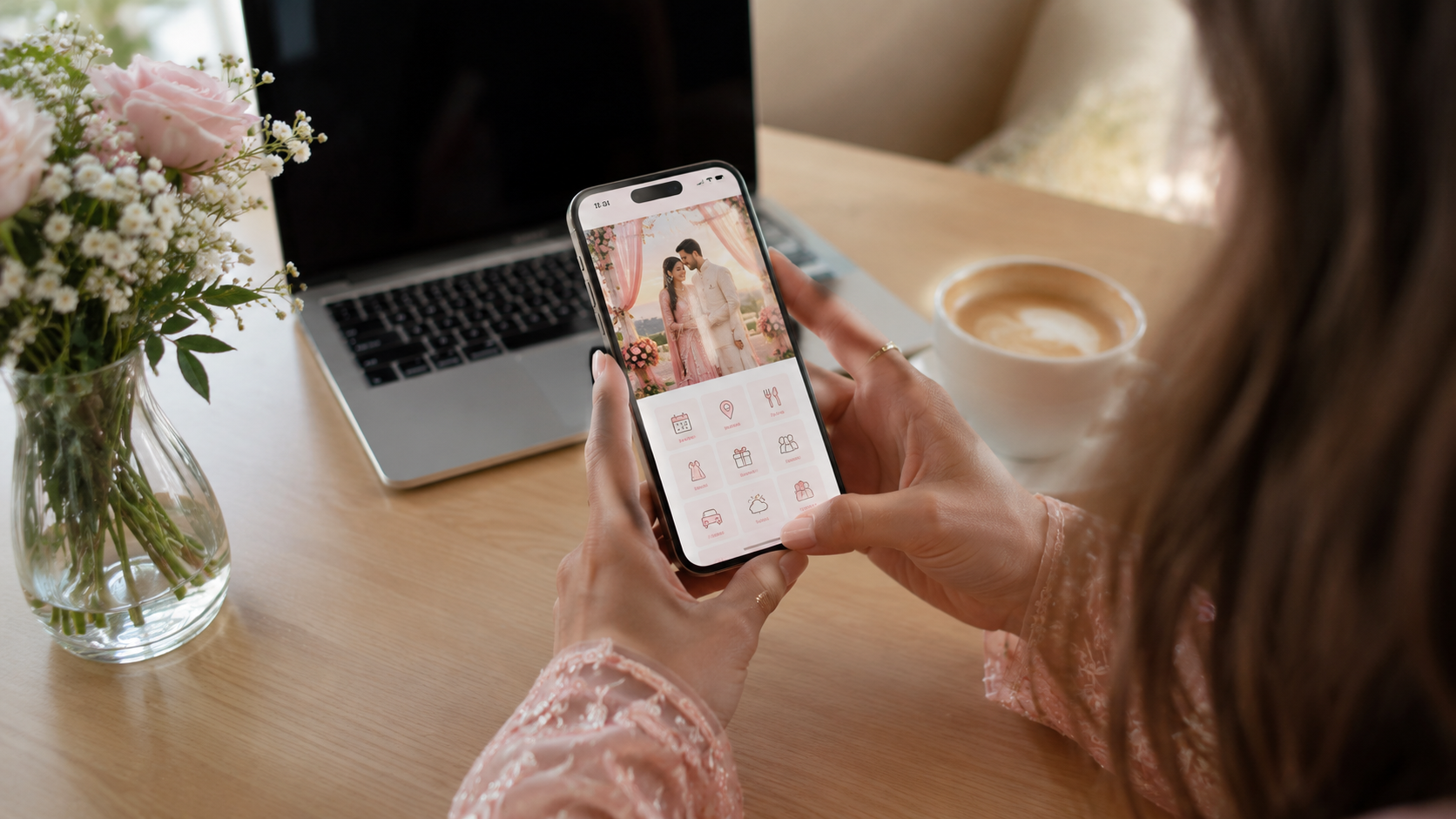
It always starts with good intentions. You create a WhatsApp group, add three hundred contacts, and tell yourself this will keep everyone organized. Then within forty eight hours the group is a wall of good morning messages, a debate about which flight route is better, seventeen laughing emojis, and somewhere buried deep in the scroll, the actual dress code for the sangeet that your cousin still cannot find. Someone missed the haldi because they never saw the time change. Someone else showed up to the wrong venue because there were two groups and they were added to the wrong one. You spent the week before the most important celebration of your life playing the role of a human helpdesk, answering the same four questions on repeat.
This is the reality of WhatsApp wedding planning in 2026, and it is happening to nearly every Indian couple managing a multi-event wedding in the US. The tool was never designed for this. It was built for casual conversation, not for coordinating three hundred guests across five events over four days in a city where most of those guests flew in from another time zone. With 89% of guests now expecting digital
RSVP and clear centralized communication, sending a WhatsApp forward is no longer just an inconvenience. It is a gap between the wedding you planned and the experience your guests actually had.
The Real Problem With WhatsApp as a Wedding Tool
WhatsApp is not a bad app. It is a brilliant app for what it was built to do. The problem is that Indian families in the US have quietly adopted it as the default infrastructure for something it was never designed to handle, which is orchestrating a complex multi-layered celebration with guests spread across multiple countries, time zones, and levels of tech comfort.
The core issue is that information in a WhatsApp group does not stay visible. A message sent at noon is buried by evening. A critical update shared on Tuesday gets lost under thirty responses and a thread about parking. Guests miss things not because they do not care but because the format makes it structurally impossible for important information to remain accessible. When a guest misses the timing of an event or shows up underdressed because they missed the dress code message, the social discomfort lands on them even though the failure was in the communication system, not in their effort.
There is also the problem of audience. A WhatsApp group built for wedding updates inevitably becomes a social space, which is wonderful for family bonding and genuinely terrible for logistics. You cannot control that and you should not have to. The answer is not to manage the group better. The answer is to use a different tool entirely.
What Your Guests Actually Need
When you think about this from the guest's perspective, the requirements are simple and they are not being met by a group chat. A guest flying from California to New Jersey for a three-day Indian wedding needs to know clearly which events they are invited to, the exact timing and location of each one, what to wear to each function, where they are staying and how to get between the hotel and the venue, and who to contact if something changes.
They need to find that information at any point without scrolling through two days of unrelated messages. They need it in a format that works on their phone without creating an account, downloading an app, or zooming into a desktop layout. And for a diaspora wedding where guests include tech-comfortable cousins in their thirties, parents' generation who may not be on every platform, and extended family in India joining remotely, the experience needs to work for all of them without any of them needing to ask for help.
A WhatsApp forward does none of this reliably. A well-designed wedding website or digital invitation platform does all of it.
The Guest-Level Visibility Problem Nobody Talks About
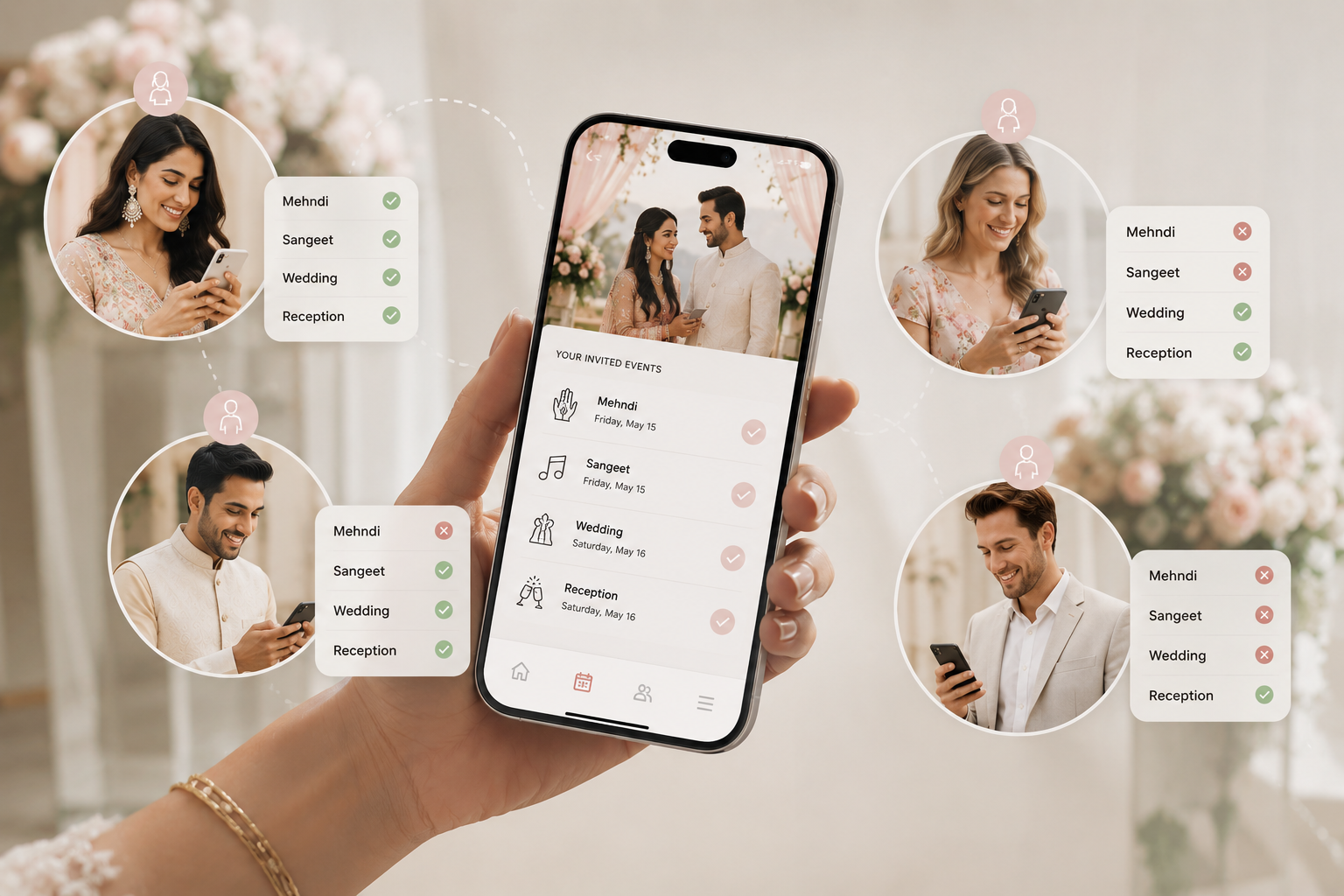
There is a layer to this that goes beyond logistics and it is one of the most delicate parts of planning a large Indian wedding. Not every guest is invited to every event. The mehndi might be intimate, the haldi might be family-only, the reception might open to a wider circle. Managing this with a WhatsApp group means either creating multiple groups and hoping people are added to the right ones, or sending one giant update to everyone with awkward language about who is and is not invited to specific functions.
Both approaches create confusion and worse, they create hurt feelings. When a guest who was not invited to the haldi sees photos before receiving any communication explaining the structure, the gap in their experience begins before the wedding even starts. The solution is guest-level visibility, where each person receives information only about the events they are specifically invited to. This is not technically possible in a WhatsApp group. It is entirely standard in a properly built digital wedding platform, and for Indian couples managing complex multi-event invitation lists it is one of the most genuinely valuable things technology can offer.
What This Looks Like When Done Well

When a couple builds a proper digital wedding experience instead of relying on group chats, the difference in the guest experience is immediate. A guest receives a beautifully designed digital invitation that reflects the couple's personality. They click through to a wedding website where they can see the full schedule of events they are invited to, the venue with a map link, accommodation details, dress code guidance for each function, and a clean RSVP option that takes under two minutes to complete.
If something changes, the couple updates the website once and every guest sees the correct information next time they check. No panicked group messages, no corrections buried under reaction emojis, no guests showing up with outdated information from a screenshot taken two weeks ago. For the couple, managing RSVPs becomes a real-time dashboard rather than a mental tally assembled from thumbs-up emojis and delayed voice notes. Vendors who need headcounts get accurate numbers on time.
For NRI couples in the US specifically, this matters even more because the guest list is almost always international. When people are RSVPing from London, Mumbai, Toronto, and Texas simultaneously, you need a system that handles time zone differences and varying levels of digital familiarity without any of it becoming your problem to manage manually.
The Emotional Dimension People Underestimate

There is something beyond the practical that deserves to be said here. The way you communicate with your guests before a wedding is itself a form of hospitality. It signals to every person on your guest list how much thought you put into their experience and how much you valued their presence enough to make showing up easy for them.
A WhatsApp forward that looks like every other message in someone's phone does not communicate that. A beautifully designed, clearly organized, personalized digital experience does. For a diaspora couple whose guests flew eight hours and took days off work to be there, that signal matters deeply.
These guests are not attending a local event. They are making a real investment in being part of your moment, and the communication they receive before they arrive should honor that investment.
This is especially true for the older generation of guests, the parents' friends, the aunties and uncles, the people for whom attending this wedding is an act of deep love and cultural connection. When the experience of receiving your wedding communication is effortless and beautiful rather than confusing and scattered, it tells them that you thought about them. That is a form of care that people feel even if they never say it out loud.
Frequently Asked Questions
Is WhatsApp okay for wedding communication if used carefully? WhatsApp works well for informal updates and real-time coordination among the close inner circle managing logistics together. It does not work as the primary communication channel for hundreds of guests attending multiple events, because information gets buried quickly and there is no way to ensure each guest receives only what is relevant to them.
What should a wedding website include for an Indian multi-event wedding? It should include a schedule of all events with times and venues, accommodation and hotel block details, dress code guidance for each function, an RSVP option per event, map links for each venue, and contact information for guest queries. Guest-level visibility where each person only sees their invited events is particularly important for managing the privacy of intimate functions.
How do I manage guests who are not comfortable with technology? Design your digital communication to require no account creation, no app download, and to load cleanly on any mobile phone. For guests who are genuinely not tech-comfortable, a single trusted family member can be their point of contact and relay information from the platform directly to them, which is far simpler than managing communication manually.
Do Indivites automatically notify guests when something changes? When you update any detail on Indivites, every guest sees the correct information the next time they open their invitation or visit the wedding website. One change in one place and everyone is automatically up to date.
What is the right RSVP system for a wedding with guests in multiple countries? You need a per-event RSVP rather than a single confirmation for the whole wedding, since different guests attend different functions. Digital RSVP tools with automatic reminders and a real-time response dashboard are significantly more reliable than tracking responses through a chat thread. The tool should be mobile-friendly and require no international payment barriers or account setups to confirm attendance.
When should the wedding website go live relative to the invitation? The website should be live before or alongside your save the date so guests have somewhere to go from the very first communication. By the time the formal invitation goes out, the full event schedule, accommodation details, and RSVP functionality should already be ready so guests can act on it immediately.